

Content licensing for AI training: three data sources compared

Blog categories
Related article



For platforms
License original, human-reviewed content at scale.
Content licensing for AI training is one of three ways AI developers can source the text their models learn from. The other two are scraping the open web and generating synthetic data with existing models. Each option has its own pros and cons, and the choices you make can reverberate into the future.
This post looks at each approach in turn, then compares them side by side. Note that, while some options may be cheap now, they often have hidden costs down the road. For example, you may save money upfront by using scraped data, but those savings could be devoured by legal fees if rights holders subsequently object to your use of their content.
Scraped data is the cheapest option but carries high legal risk
Scraping is the cheapest and fastest way to build a large training corpus. Crawlers can collect enormous volumes of text at little cost beyond the core infrastructure. Consequently, scraped web data has formed the base of many large language models.
The savings come with exposure. Scraped content is usually collected without permission from the people who own it which makes it an inherently risky proposition, and developers have found themselves in the hot seat over how training data was gathered.
Quality control is also a problem.
The open web is a hodgepodge of truth and lies, fact and fiction, and precious little of it is verified.
Provenance is typically absent—once a page is scraped and processed, there is often no reliable record of where it came from or who held the rights.
Synthetic data fills gaps but inherits the generating model’s risk
Synthetic data is text produced by an existing model and used to train another. The advantage here is that it can fill gaps where real data is scarce, and it can be generated in large quantities on demand. The main cost is the compute needed to generate it.
However, it’s limited by its origin. Synthetic data can only be as varied and accurate as the model that produced it, so variety and quality can ultimately be limited. Over repeated rounds, models trained heavily on synthetic output can drift away from real-world language and facts, a problem researchers call model collapse. It’s a bit like endlessly photocopying a photocopy.
With each successive copy, the quality will degrade.
The legal picture is less clear than it first appears. Generating new text does not create a fresh set of rights. If the generating model was trained on scraped material, the synthetic data inherits that model's risk. And provenance only reaches as far as the generating model, not the human-created sources behind it.
Licensed content costs more but documents rights and provenance upfront
Licensed content is acquired through agreements with the publishers and creators who own it. It costs more than scraping, and the cost can rise with volume. Its scale is also limited by the size of the publisher network a developer can reach.
The main benefit of licensed content is certainty. Rights are documented before the content is used, which minimizes legal risk. Licensed material from established publishers has already been through editorial review, so its quality is consistent. And because each item comes from a known source under known terms, its provenance is recorded at the point of origin rather than reconstructed after the fact.
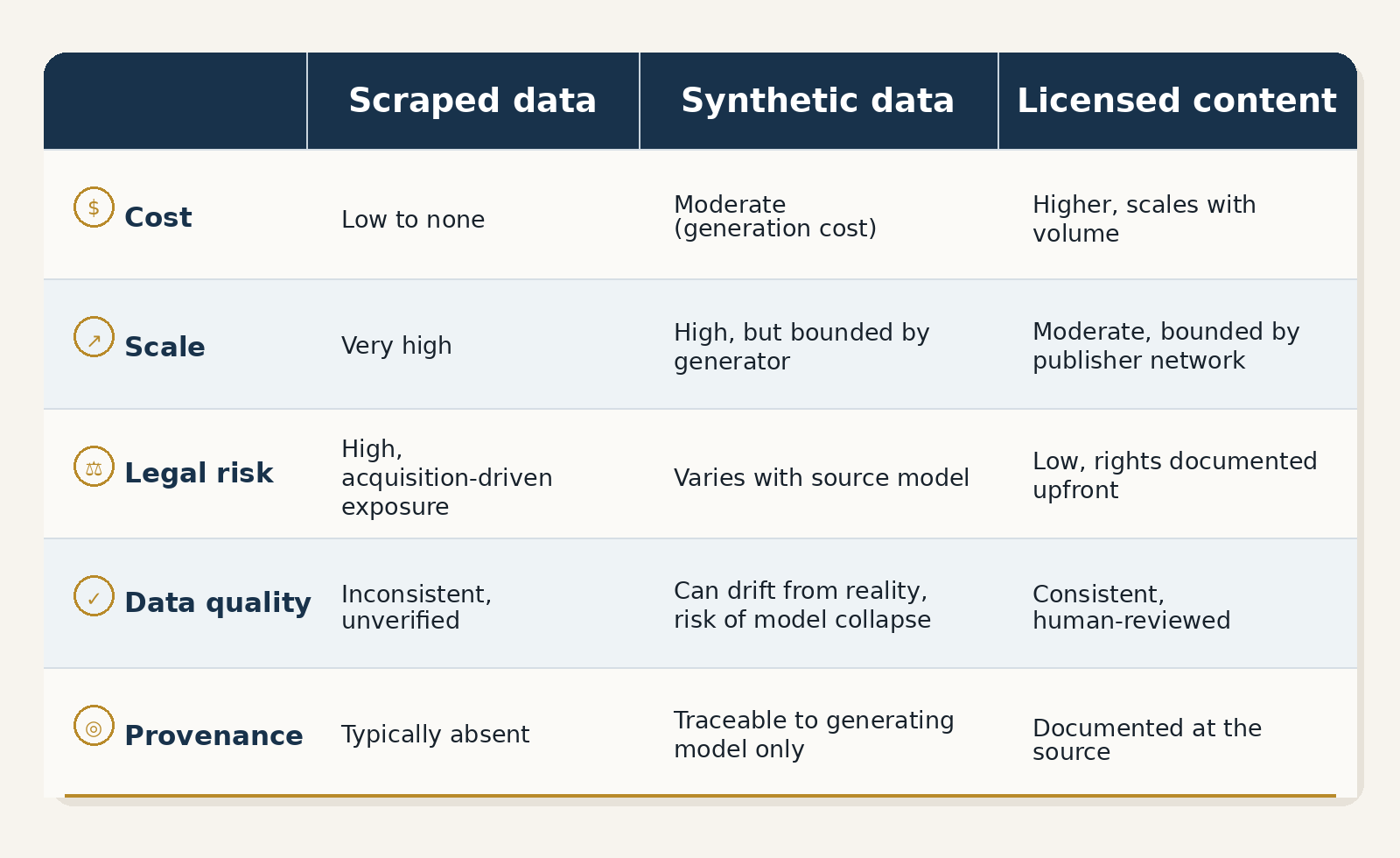
Licensed, scraped, and synthetic data compared on cost, risk, and quality
What the comparison shows
Scraped and synthetic data win on cost and scale. Licensed content wins on legal risk, quality, and provenance. The question for a developer is which of those factors will matter most over the life of a model.
Cost and scale are front-loaded advantages. Legal risk and missing provenance tend to rear their heads later, when a model is already in production and the training data can no longer be easily separated out. Developers should also be mindful of the fact that courts and regulators are increasingly interested in how training data is acquired, and buyers of AI products are starting to ask the same questions.
The three approaches are not mutually exclusive. Many developers will use some combination. But licensed content is the only one of the three that can answer the provenance question with a document rather than an estimate.
That makes licensed content especially well suited to production models and to any system likely to face legal or regulatory scrutiny. A model used for research or internal testing may tolerate some uncertainty about its training data. On the other hand, if a model is going to be deployed to customers or used in highly regulated sectors such as finance, healthcare, or law, the question becomes far more salient.
Licensed content gives developers that answer, backed by agreements they can produce on request.
Newstex supplies rights-cleared content with provenance documented at the source
Newstex helps AI developers build on licensed content without assembling a publisher network themselves. We provide rights-cleared content from a broad range of publishers and creators, with provenance documented at the source, so developers know what they are training on and that they have the right to use it. For teams that want the quality and legal certainty of licensed content, Newstex offers a direct path to it.
Want to see how Newstex delivers rights-cleared datasets for AI training? Request a demo here→ newstex.com/request-demo
Want to see our data for yourself? Get content samples here→ newstex.com/get-content-samples
About the author,
José Mauricio Duque
José Mauricio Duque, based in Barranquilla, Colombia, is Brand Manager at Newstex. He has built digital content and marketing programs across digital education, design, the startup ecosystem, and government, including Colombia's Ministry of Information Technologies and Startup Grind. He holds a Bachelor's in Business Administration and a Master's in Educational Technologies.


