

Licensed content for RAG: what AI developers need from a news feed


Blog categories
Related article


For platforms
License original, human-reviewed content at scale.
Licensed content for RAG is what lets an AI product answer with current, citable information without taking on the rights-risk of scraping. But a license alone does not make a news feed useful for retrieval-augmented generation.
For AI developers, the practical questions are much more specific. How quickly does new content arrive? What happens when a publisher corrects a story? Can the system distinguish two versions of the same article? Does the feed include enough metadata to filter and rank results? Can an answer point users back to the source?
These requirements are becoming more important as AI licensing shifts from one-time access to training data toward live access at inference time. Rob Kelly of Media and the Machine has documented a clear decline in the share of publicly announced deals that include training rights, while recent agreements increasingly emphasize fresh content, retrieval, attribution and links. His research describes the broader shift as one from licensing content to build better models toward licensing it to deliver better answers.
In a separate June 2026 analysis of 91 publicly announced AI licensing deals, Kelly found that deals involving attribution and live access increased from 2 in 2023 to 11 in 2024 and 18 in 2025, with 34 projected for 2026.
For AI teams evaluating a news source, that changes the calculus considerably.
Grounding rights and training rights are separate licenses
A license to train a model does not automatically grant permission to retrieve the same content later and display information from it in an answer. Likewise, a license for retrieval or grounding does not necessarily give a developer the right to incorporate that material into model weights.
That distinction needs to be explicit in the contract.
If your use case involves training as well as retrieval, look for rights that cover each activity separately rather than assuming one implies the other.
For a fuller discussion of the licensing models, see Editorial content licensing for AI training and grounding. Teams specifically building training datasets can also review rights-cleared datasets for model training.
Freshness determines whether retrieval helps or hurts
RAG solves a problem that model training cannot easily solve: Knowing what happened recently.
A system trained last year cannot answer reliably about an announcement made this morning unless it can retrieve outside information. That makes the right update cadence an essential point rather than an optional extra.
It also makes corrections important. News is not frozen in time. Stories are updated and occasionally corrected or withdrawn. Your retrieval pipeline needs a defined way to receive those changes and propagate them through the index.
A retracted claim that continues to surface in an AI answer is egg on the face of the developer.
This is one reason current AI licensing agreements increasingly focus on live access. Because of the 2026 agreement between Microsoft and Nine, for example, Copilot can reference real-time reporting from Nine publications when grounding responses. Microsoft said the arrangement would give users access to verified facts while directing them to the original journalism. For more on why recency matters when licensing news, see News content licensing for AI.
Metadata makes retrieval accurate
Full text is only one part of a useful RAG feed. Metadata ultimately determines how effectively a retrieval system can use content. Useful fields can include publication and update timestamps, source information, categories, entities, geographic information, and unique article identifiers. These help the AI find the most accurate information for a given query.
Unique identifiers are especially important when content changes.
Without a persistent ID, a correction can look like a new document instead of an updated version of an existing one.
The result can be duplicate passages or contradictory evidence inside the same retrieval context.
Provenance metadata matters for the same reason. An AI system should be able to answer not only "What evidence supports this?" but "Where did this evidence come from?"
Attribution is becoming a contract term
Attribution is increasingly part of the commercial agreement rather than an optional interface. As mentioned before, Copilot can use Nine journalism to ground answers while displaying references and directing readers to Nine’s sites for the complete story.
Similarly, News/Media Alliance’s agreement with Bria goes further by connecting attribution directly to compensation. Bria’s system is designed to identify the licensed material used in AI-generated outputs, assign credit to it and distribute revenue to participating publishers according to usage. The Alliance explicitly describes the arrangement as a licensing model for RAG.
For engineering teams, the moral of the story is that attribution requirements need to be baked into the product architecture. If a license requires a publisher name, article reference or click-through link, the retrieval layer must preserve the information needed to generate it reliably.
Delivery format sets the engineering cost
A feed can contain excellent journalism and still be unwieldy to use if every source requires its own ingestion logic. For production RAG systems, consistency is vital. Full-text XML or JSON provides structured fields that can be fed into a common indexing pipeline. A standardized schema also reduces the amount of publisher-specific parsing required as coverage expands.
The other question is how the content arrives. Bulk access may suit model evaluation, historical analysis or backfilling an index. A continuously updated feed is more appropriate when the product needs to answer questions about current events.
The ideal source should not force an engineering team to build and maintain dozens or hundreds of separate integrations just to broaden coverage.
Seven questions separate a usable RAG source from a risky one
The evaluation can be reduced to seven practical questions:
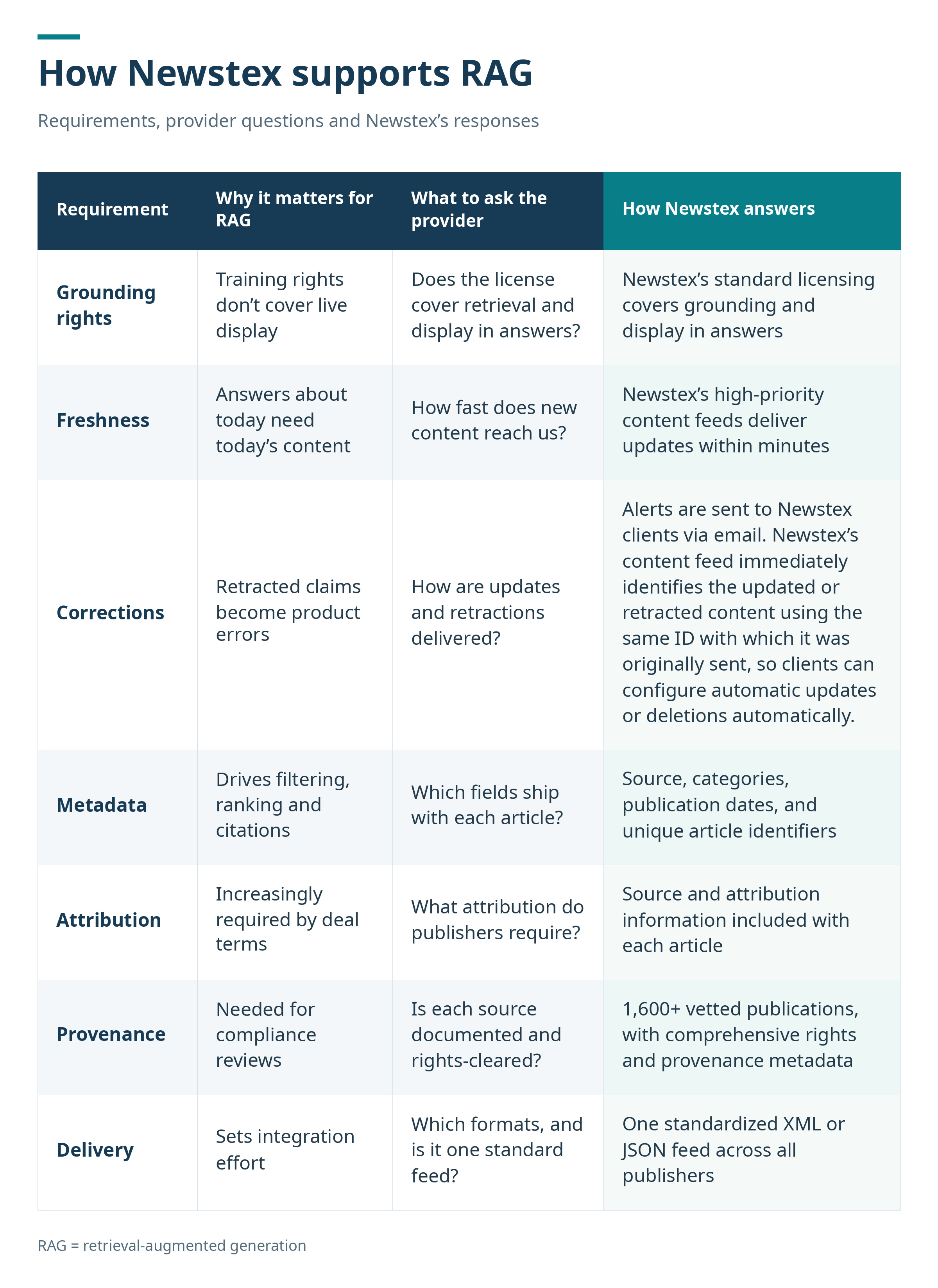
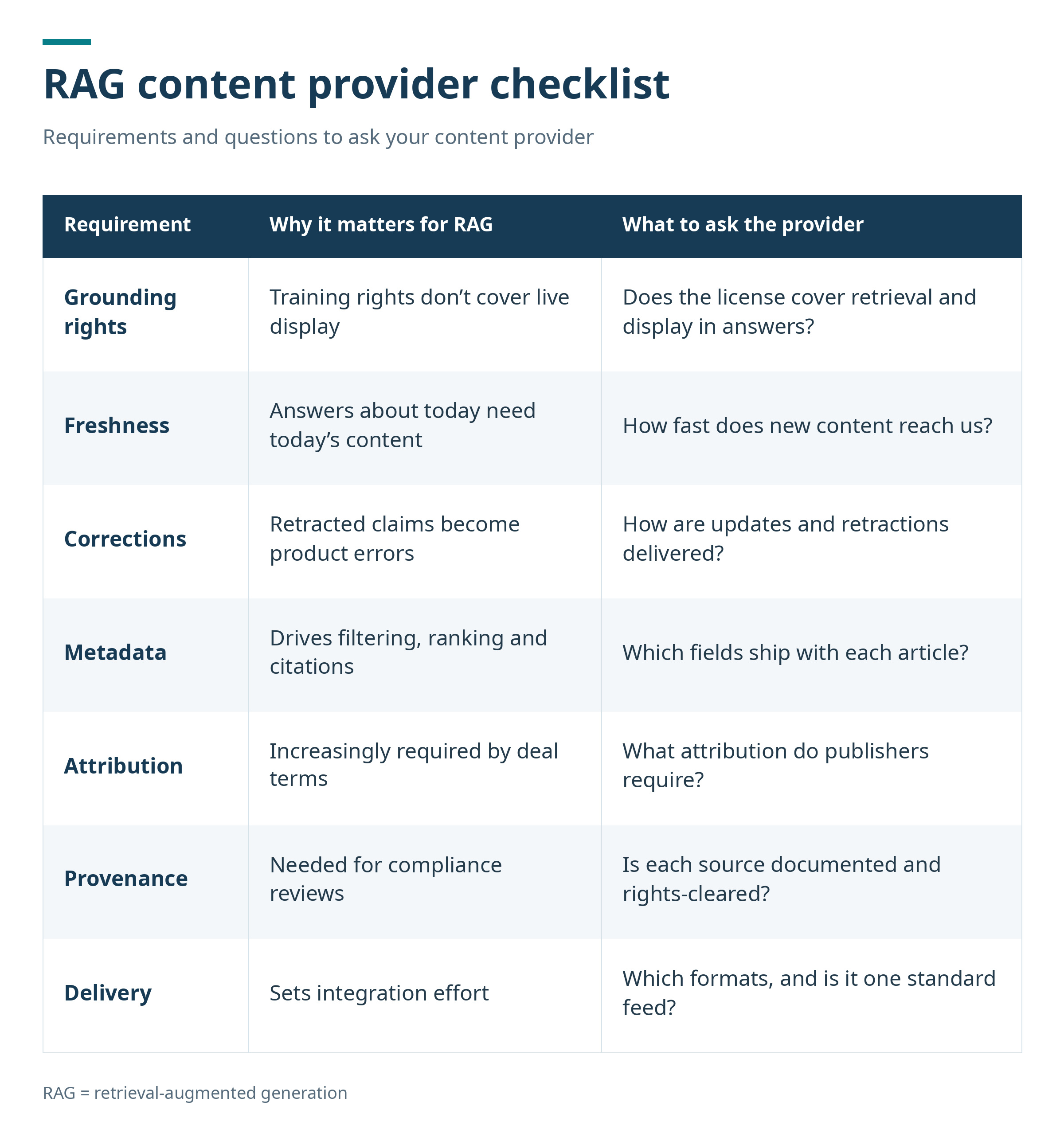
These questions also provide a useful dividing line between a web data source and an actual RAG data product. A source that cannot answer them may still be useful, but the AI developer will have to absorb more of the risk.
For additional resources on evaluating licensed sources, visit the content licensing hub.
Where Newstex fits
Newstex addresses many of these requirements through a single licensing and delivery pipeline.
Our network includes more than 1,600 vetted publications, with sources reviewed by our editorial team before entering the catalog. Content is delivered as standardized XML or JSON rather than requiring separate integrations for individual publishers. Newstex also enriches articles with metadata for search and analysis, including source and attribution information, categories, publication dates and other fields used for filtering and discovery.
Newstex processes more than 1.5 million articles each month and provides licensing details, unique article identifiers and provenance metadata that allow content to be traced to its source. Its feeds are perfect for applications such as training, evaluation and grounding.
Customers can use the Newstex Customer Portal to review publications and manage source approvals. The portal connects licensing information, publication metadata and source management in one interface.
For teams evaluating content licensing for AI developers, that means the technical evaluation can focus on the feed and the sources rather than on negotiating and normalizing every publisher separately.
That division of labor is one reason AskNews works with Newstex. Robert Caulk, founder and CEO of AskNews, described licensing as a process that has to be "balanced, transparent, and built with trust." He said his team wanted to concentrate on science and engineering while relying on our experience managing relationships and licensing with publishers.
The broader lesson is straightforward. A RAG feed should not be evaluated only by how much content it contains. Rights, freshness, metadata, provenance, attribution and delivery all affect whether that content can safely become part of an AI product.
Request a demo to see how Newstex delivers licensed feeds for AI applications.
Get content samples to see the feed format and metadata firsthand.
About the author,
José Mauricio Duque
José Mauricio Duque, based in Barranquilla, Colombia, is Brand Manager at Newstex. He has built digital content and marketing programs across digital education, design, the startup ecosystem, and government, including Colombia's Ministry of Information Technologies and Startup Grind. He holds a Bachelor's in Business Administration and a Master's in Educational Technologies.


