

Licensed news feeds for information platforms: what to check


Blog categories
Related article


For platforms
License original, human-reviewed content at scale.
A licensed news feed gives an information platform a continuous, rights-cleared stream of articles to deliver to its users, but they differ widely in what they actually provide. Two feeds with similar source counts can present the material in vastly different ways, and those differences ultimately decide what users can find and what the platform may do with it.
The content a platform licenses is a large part of why information databases matter to the people who use them. The criteria below set out what to check before signing.
Coverage depth matters more than source count
Like a toupee, a large source count can hide thin coverage.
A feed may list thousands of sources yet carry little beyond the wire stories and major-outlet reports that competing platforms already have.
Original commentary and specialist voices fill the gaps those sources leave. They offer the kind of in-depth, wonky coverage that general news outlets rarely reach. This approach is particularly useful for users of legal, financial, and academic platforms who need insights that go beyond the headlines.
Selectivity matters as much as breadth. A feed that admits every publication that applies passes its quality problems on to the platform, so be sure to ask how sources are vetted and how many are turned away.
Redistribution rights must match how users access content
A license is only useful if it covers the way users actually consume content. Check each for each right separately:
- Display to subscribers: Is the right to display the full text, or just excerpts or headlines?
- Archive access: May articles remain searchable after the license term ends and after a publisher ceases publishing?
- Downstream use: May users export, share, or reuse the content?
- AI features: May the content be used to generate summaries, answers, or alerts?
The last point is increasingly decisive. A platform that adds AI summaries or answers may need grounding rights, which allow a model to retrieve licensed articles and draw on them when it responds. Display rights alone may not cover that use. Our post on retrieval-augmented generation explains the difference.
Metadata determines whether content gets found
Metadata decides whether a licensed article reaches a user or sits unread in an index. Useful fields include topics, industries, stock ticker-symbols, and named entities (e.g., companies and famous people), and tone.
The fields matter less than how well they fit your platform. Consider how a feed's metadata maps to your own taxonomy. If you have to retag everything, the feed may be causing you more problems than its worth.
Consistency matters, too.
Inconsistency undermines the whole point of metadata.
Article-level provenance speeds compliance review”
Clearly attested provenance makes due diligence much easier. Each article should carry its author, its publication and update timestamps, as well as a link to the original article.
With that information attached, compliance teams can confirm where content came from and that it was licensed, without chasing publishers one by one.
One standard feed beats dozens of integrations
Every vendor feed a platform adds can have its own format, schedule and support process. This isn’t necessarily a problem for a single feed, but dozens of fees with dozens of different approaches can be a logistical nightmare.
A single feed in a standard format removes most of that work. When comparing feeds, check three things:
- Format: Whether articles arrive as XML or JSON in a documented, consistent schema.
- Latency: How long after publication an article reaches the platform.
- Corrections: Whether updates and retractions arrive automatically and replace the original, or must be handled by hand.
Our guide on how to choose content licensing for data teams compares single-provider feeds with direct publisher deals and other routes in more detail.
Platforms should control which sources they receive
A feed is easier to trust when the platform decides what goes into it.
Reviewing and approving publications before they enter the feed lets a platform exclude sources that don’t meet their needs.
Source control also keeps the feed relevant as it grows. New publications arrive only when they actually fit, not by default. Our post on the Newstex Customer Portal shows how this review works in practice.
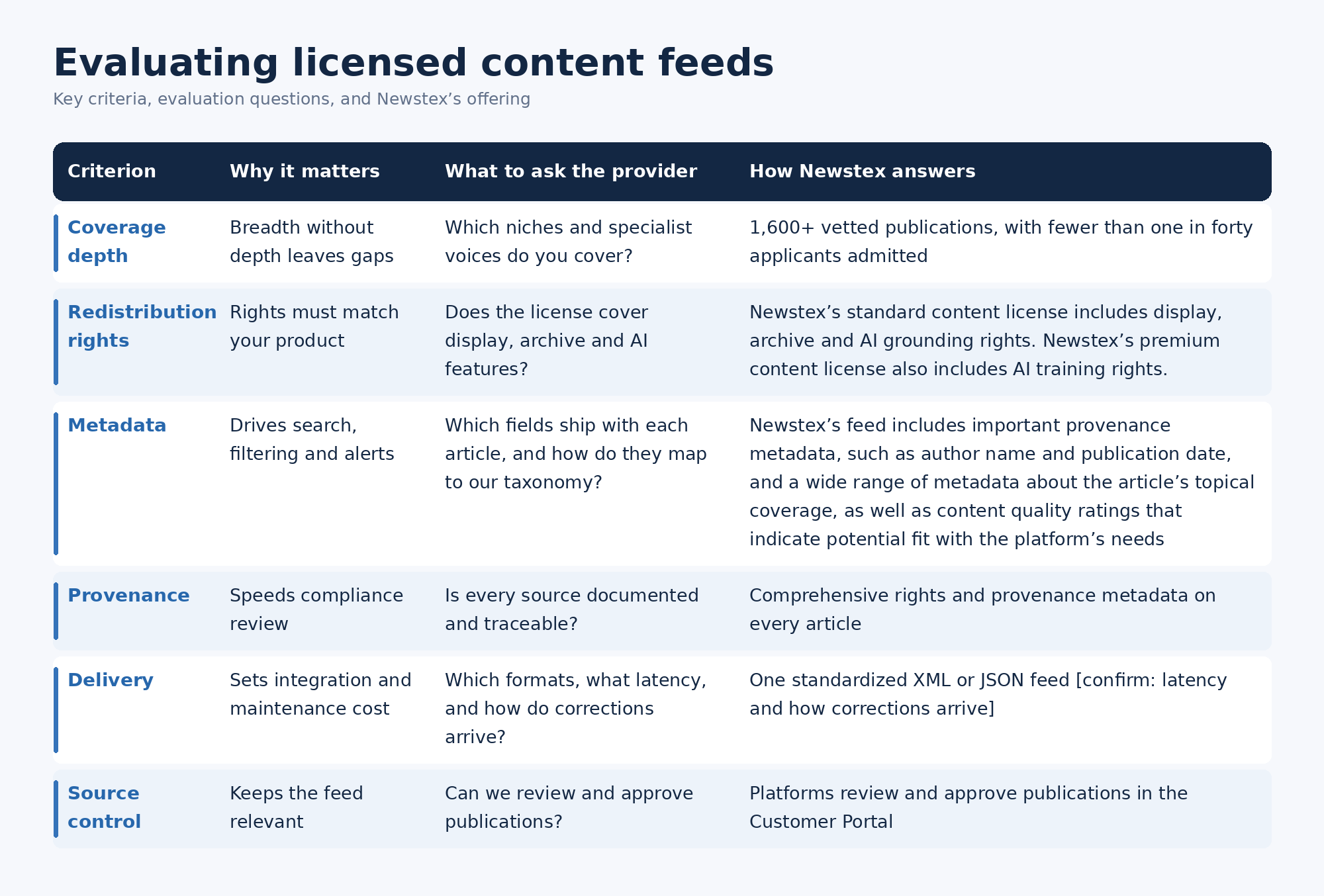
Six questions separate a strong feed from a weak one
Use these questions when comparing providers. For more on licensing models and terms, see our content licensing hub.
Newstex supplies vetted, tagged news feeds for information platforms
Newstex was built to answer these questions. For more than 20 years, we have supplied licensed content to leading legal, financial and academic platforms.
On coverage, our catalog holds more than 1,600 vetted publications, and fewer than one in forty applicants are admitted. On metadata, every article arrives tagged. On source control, platforms review and approve publications through the Customer Portal before they enter the feed.
Learn more about our content licensing for information platforms.
Request a demo to see how Newstex feeds power information platforms.
Explore the catalog to browse the publications available to license.
About the author,
José Mauricio Duque
José Mauricio Duque, based in Barranquilla, Colombia, is Brand Manager at Newstex. He has built digital content and marketing programs across digital education, design, the startup ecosystem, and government, including Colombia's Ministry of Information Technologies and Startup Grind. He holds a Bachelor's in Business Administration and a Master's in Educational Technologies.


